How to Choose Waterproof LED Tubes in 2026?
Choosing a Waterproof LED Tube in 2026 requires more than checking a product label. Moisture, dust, heat, vibration, and installation quality all affect service life. A tube may look sealed in a showroom, yet fail above a steamy production line.
Lighting engineer Martin Keller explains, “Waterproof performance depends on the whole system, not only the LED tube.” This practical view should guide every purchase. Inspect the tube body, end caps, wiring seals, driver, and mounting clips. A weak connector can defeat an otherwise strong design. Small details matter.
Look for a clearly stated IP rating, such as IP65, IP66, or IP67. Match that rating to the actual location. IP65 may suit dusty workshops and occasional water spray. IP67 can offer better protection where brief immersion is possible. Still, an IP number does not guarantee chemical resistance or long-term outdoor durability.
Check the operating temperature range. Confirm lumen output, beam angle, color temperature, and expected lifetime. Frosted tubes can reduce glare, but they may also lower delivered brightness. Transparent covers often create sharper reflections. That choice is easy to overlook.
I have seen buyers focus on wattage first. That can be a costly shortcut. Compare usable lumens per watt, not wattage alone. Review warranty terms and test documentation. UL, CE, RoHS, or equivalent certifications can support confidence, but certificates should match the exact model.
Installation deserves equal attention. Avoid tight bends, trapped moisture, and incompatible sockets. Even premium products can fail when installed carelessly. Some specifications remain unclear. Question them before ordering.
This guide explains how to compare Waterproof LED Tube options realistically, avoid attractive but weak claims, and choose lighting that performs reliably in its intended environment.
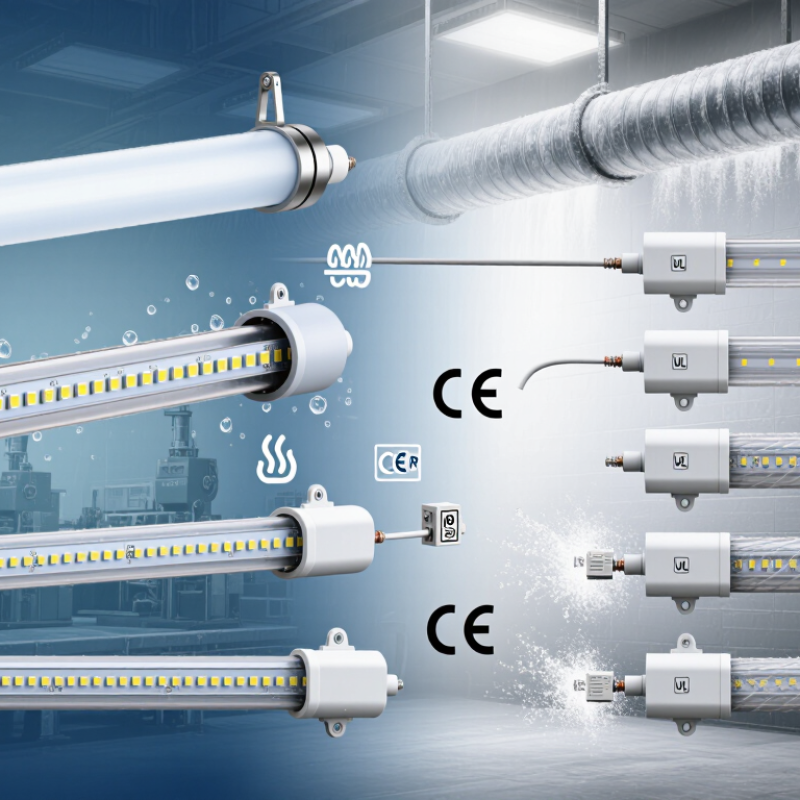
Understanding Waterproof LED Tube Ratings and Protection Levels
How to Choose Waterproof LED Tubes in 2026?
Waterproof does not mean universally safe underwater. Check the IP rating, defined by IEC 60529. The first digit measures dust protection, while the second measures water resistance. IP65 is dust-tight and resists water jets. IP66 handles stronger jets. IP67 permits temporary immersion, usually up to one metre. IP68 requires the manufacturer to state the tested depth and duration. Read the installation conditions carefully.
Small details matter. In a humid workshop, IP65 may be enough above a workbench. Near a washdown area, IP66 offers a more sensible margin. For a covered outdoor sign, inspect the end caps, cable glands, and mounting clips. One weak seal can defeat a strong rating. I have seen installers focus on the tube and ignore the connector. That mistake is surprisingly common.
Energy performance also deserves attention. The U.S. Department of Energy reports that LED products can use at least 75% less energy and last up to 25 times longer than incandescent lighting. However, tube efficiency varies with optics, temperature, and driver quality. Compare delivered lumens, watts, operating temperature, and rated life. Do not trust “waterproof” printed alone. IEC 60529 testing is controlled, not magical. Real dust, poor drainage, and careless sealing can still shorten service life.
How to Choose Waterproof LED Tubes in 2026?
Understanding Waterproof LED Tube Ratings and Protection Levels
The IP code is defined by IEC 60529. The first digit indicates protection against solid particles and dust, from 0 to 6. The second digit indicates protection against water, from 0 to 9. For LED tubes, IP65 generally provides dust-tight protection and protection against water jets, while IP67 adds temporary immersion protection. Select the rating according to the installation environment, exposure to water, cleaning method, and required mounting position.
Identifying the Right LED Tube Size, Shape, and Installation Type
Choosing a waterproof LED tube starts with dimensions, not brightness. Measure the existing tube, socket spacing, and fixture length. A common four-foot T8 tube is about 1,200 millimeters long, but housing tolerances can cause installation problems. T5 tubes are slimmer and often use different sockets. Shape matters too. A bare linear tube suits open fixtures, while an integrated batten provides better sealing in damp rooms. Check the housing depth before ordering. I have seen bright tubes fail because their bodies touched the cover.
Installation type deserves equal attention. Ballast-compatible tubes may simplify replacement, but older ballasts can waste energy or create flicker. Direct-wire models remove the ballast, yet they require qualified electrical work and careful wiring checks. The U.S. Department of Energy’s Solid-State Lighting reports show LED systems can exceed 150 lumens per watt, but real performance depends on drivers, temperature, and optics. The International Energy Agency estimates lighting uses about 15% of global electricity consumption. Efficiency is important, but poor installation can erase part of the benefit.
Tips: Match the tube length to the measured fixture, not the label. Select IP65 for water jets; IP67 supports temporary immersion under IEC 60529 testing. Confirm the operating temperature and gasket condition. For wet workshops, choose a sealed tube with a transparent cover and stainless mounting clips. I would also photograph the existing wiring first. It prevents assumptions, although it does not replace professional inspection. One more practical detail: test the light after ten minutes. Heat, flicker, or condensation may reveal a choice that looked correct on paper.
Comparing Brightness, Color Temperature, and Energy Efficiency
Choosing waterproof LED tubes in 2026 starts with measured light, not impressive wattage claims. In a damp workshop, I compare lumens, beam angle, and spacing before checking the package. A 4,000-lumen tube can still look weak when mounted high or behind a diffuser. Use a light meter at the work surface, ideally after installation. Real conditions matter.
Color temperature changes how a space feels and functions. Around 3,000K gives warmer light for storage rooms and covered walkways. Neutral 4,000K often suits garages, kitchens, and maintenance areas. Higher values can improve visual alertness, but they may feel harsh on reflective floors. Check CRI too; 80 is common, while 90 or higher helps with wiring colors and inspection tasks. I once chose a cooler tube for a utility room and regretted it. The brightness was adequate, yet the room felt sterile.
For energy efficiency, compare lumens per watt, driver losses, and rated lifetime. A tube producing 130 lumens per watt may outperform a brighter-looking model using more electricity. Verify performance at the required temperature, because cold rooms and enclosed fixtures can change output. Match the IP rating to actual water exposure, and check sealed ends and test documentation. Do not trust lifetime alone. It can ignore heat, switching cycles, and installation quality. My own estimates have been too optimistic when I ignored cleaning and voltage variation. Measure actual power with a meter, then compare annual use and replacement access.
How to Choose Waterproof LED Tubes in 2026? — Comparing Brightness, Color Temperature, and Energy Efficiency
The table below compares representative waterproof LED tube specifications for common commercial, industrial, food-service, parking, and outdoor applications. Actual performance may vary with optics, ambient temperature, installation method, and power-supply configuration.
| Application Profile | Typical Length | Rated Power | Initial Lumens | System Efficacy | Color Temperature | Color Rendering (CRI) | Ingress Protection | Rated Life | Recommended Use |
| Low-Power Utility | 600 mm / 2 ft | 9 W | 1,150 lm | 128 lm/W | 4,000 K Neutral White | CRI ≥80 | IP65 | 50,000 hours | Storage rooms, corridors, utility areas, and small service spaces |
| Balanced General Lighting | 1,200 mm / 4 ft | 18 W | 2,400 lm | 133 lm/W | 4,000 K Neutral White | CRI ≥80 | IP65 | 50,000 hours | Workshops, retail back rooms, covered walkways, and general commercial areas |
| High-Brightness Work Area | 1,200 mm / 4 ft | 24 W | 3,360 lm | 140 lm/W | 5,000 K Cool White | CRI ≥80 | IP66 | 60,000 hours | Workshops, loading bays, production support areas, and high-ceiling spaces |
| High-Color-Quality | 1,200 mm / 4 ft | 22 W | 2,750 lm | 125 lm/W | 4,000 K Neutral White | CRI ≥90 | IP65 | 50,000 hours | Retail displays, inspection areas, studios, and spaces where color accuracy matters |
| Cold-Environment | 1,200 mm / 4 ft | 20 W | 2,600 lm | 130 lm/W | 5,000 K Cool White | CRI ≥80 | IP66 | 60,000 hours | Cold storage, refrigerated work areas, and unheated buildings |
| Outdoor / Washdown | 1,500 mm / 5 ft | 32 W | 4,160 lm | 130 lm/W | 5,000 K Cool White | CRI ≥80 | IP67 | 60,000 hours | Car parks, covered outdoor areas, food-processing zones, and frequent washdown locations |
| Warm-White Comfort | 1,200 mm / 4 ft | 18 W | 2,250 lm | 125 lm/W | 3,000 K Warm White | CRI ≥80 | IP65 | 50,000 hours | Hospitality areas, residential service spaces, entrances, and visually comfortable environments |
Selection guidelines: Choose higher lumen output for high ceilings or wide mounting spacing. Use 3,000 K for a warmer and more comfortable appearance, 4,000 K for balanced general lighting, and 5,000 K for a brighter, more alert visual environment. Select CRI ≥90 when accurate color identification is important. IP65 protects against dust and water jets, IP66 provides stronger water-jet protection, and IP67 adds temporary immersion protection. Always verify the required input voltage, wiring method, operating temperature range, and local safety certifications before installation.
Checking Materials, Lifespan, Safety, and Environmental Performance
How to Choose Waterproof LED Tubes in 2026?
Choosing a waterproof LED tube in 2026 requires more than checking its IP rating. That rating describes water resistance, not total product quality. Examine the housing material, seals, diffuser, and cable entries closely. Polycarbonate can resist impact, while UV-stabilized materials reduce yellowing outdoors. Silicone gaskets should remain flexible after repeated temperature changes. I have seen cheap seals harden within one winter. It was an expensive lesson.
Lifespan depends heavily on heat control and installation conditions. Look for tested lumen-maintenance data, not only a claimed operating lifetime. A strong aluminum heat path helps protect LEDs and drivers from heat buildup. Check operating temperatures, switching limits, and warranty terms. Safety also requires secure connectors, proper insulation, and clear wet-location instructions. An IP rating does not replace correct installation. Verify independent test reports and relevant electrical certifications. Local requirements still matter.
Environmental performance deserves equal attention. Compare energy efficiency, expected light output, repair options, and packaging volume. A tube using less electricity can reduce operating emissions over many years. Mercury-free construction is important, but disposal still needs proper recycling channels. Replaceable drivers may extend service life, although they can complicate maintenance. That trade-off is easy to overlook. Ask suppliers for material declarations and realistic performance data. Marketing language can sound convincing, yet measured evidence is more useful.
Selecting Compatible Drivers, Controls, and Maintenance Requirements
Choosing a waterproof LED tube starts with the driver, not the fixture’s appearance. Confirm the tube’s input type, voltage, current, and dimming method before ordering. A constant-current tube cannot safely use a constant-voltage driver. Check the driver’s output range against the tube’s rated requirements. Leave headroom, but do not oversize it carelessly. An overloaded driver may flicker, overheat, or fail early. In wet areas, select a driver with suitable ingress protection and secure electrical connections.
Controls need equal attention. A wall dimmer, occupancy sensor, or timer must match the driver’s control protocol. For example, a mains dimmer may not operate a low-voltage dimming system. Test one complete circuit before installing dozens of tubes. I have found that short trials reveal buzzing, delayed starts, and uneven dimming. Those faults become expensive when ceiling access is difficult. Do not guess. “Waterproof” does not always mean suitable for constant submersion. Review the IP rating, cable glands, seals, and mounting position.
Maintenance begins with installation records. Record driver locations, circuit loads, control settings, and replacement dates. Inspect seals and cable entries twice yearly, especially after cleaning or storms. Look for condensation, cracked lenses, loose terminals, and darkened tube ends. Clean lenses with a soft, damp cloth; harsh solvents can damage plastics. Replace failed parts with electrically compatible units, not similar-looking ones. Ratings can vary between test conditions. Keep records. Verify the technical sheet, and ask a qualified electrician to review uncertain installations.